Vestibular Function and Healthy Aging: Why Inner-Ear Balance Matters
Vestibular function often declines with age, affecting gaze and balance. Learn what the evidence shows, how testing works, and why falls have many causes.
Table of Contents
DISCLAIMER
This article is for informational purposes only and does not constitute medical advice. The statements in this article have not been evaluated by the FDA. The information presented is based on published research and should not be used as a substitute for professional medical guidance. Consult your physician before starting any supplement or health protocol.
Standing still is an active neurological task. The brain continuously reconciles vision, touch and pressure from the feet, joint position, and signals from tiny motion sensors in the inner ear. Vestibular function in healthy aging matters because these signals stabilize the eyes during head movement and help the body distinguish a safe lean from a fall.
Age can affect every part of this system, but dizziness is not an inevitable or single-cause feature of getting older. Medication effects, vision changes, neuropathy, cardiovascular problems, and neurological disease can mimic or compound vestibular loss. The practical challenge is to identify which inputs are failing and which can be trained or supported.
The balance organs inside the inner ear
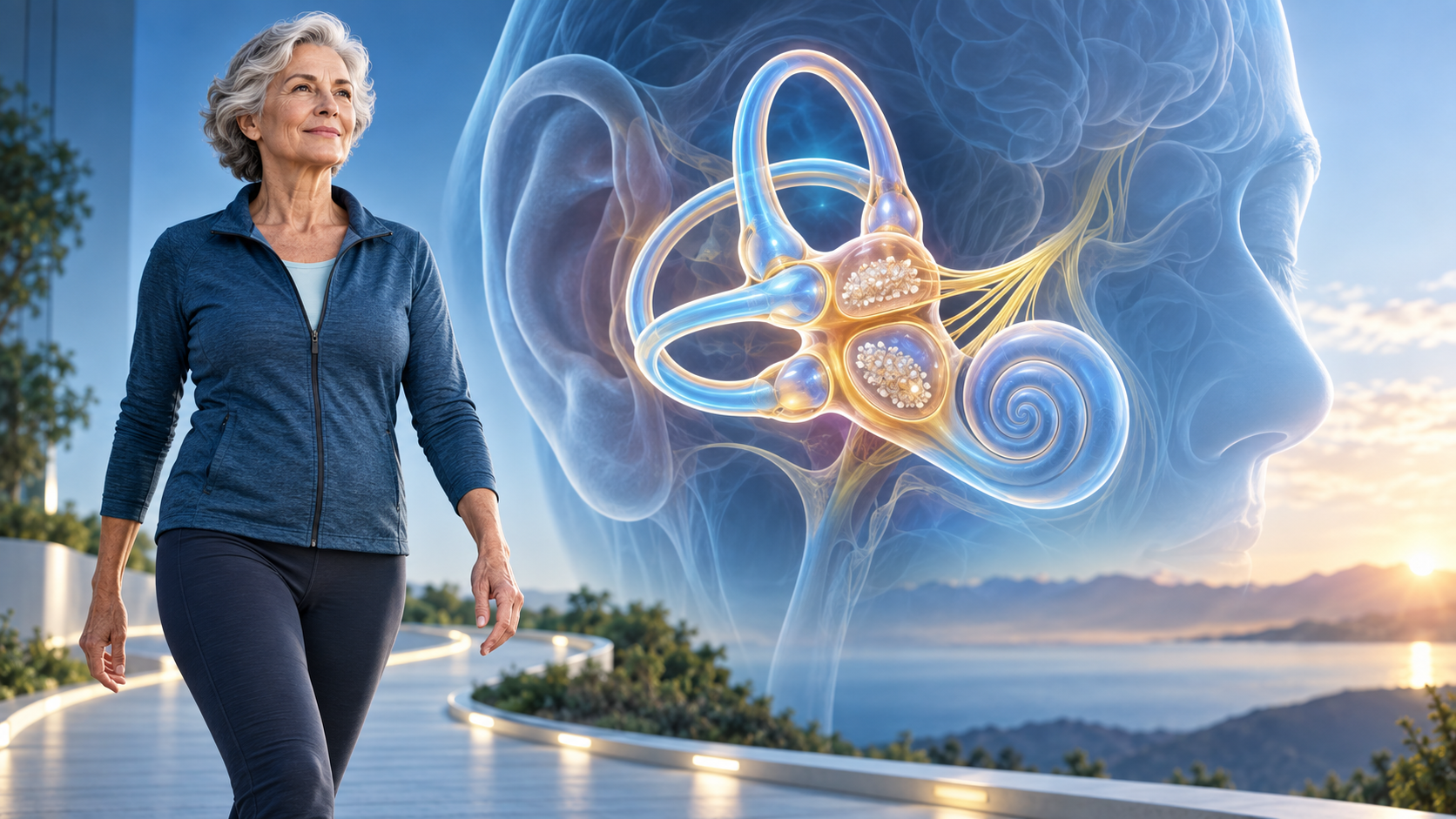
Each inner ear contains three semicircular canals that sense angular head acceleration. Two otolith organs—the utricle and saccule—respond to linear acceleration and gravity. Hair cells convert fluid movement and shifts of microscopic calcium-carbonate crystals into neural signals carried by the vestibular nerve.
Those signals drive the vestibulo-ocular reflex. When the head turns left, the eyes move right by a precisely calibrated amount so the visual world remains stable. The same information reaches spinal and cerebellar networks that adjust posture. A person can therefore have trouble reading a sign while walking, feel unsteady in darkness, or veer on uneven ground even without a spinning sensation.
The brain normally combines partially redundant information. Bright lighting can compensate for a weak vestibular signal; firm ground can compensate for reduced vision. Problems become more obvious when several inputs are challenged at once—for example, walking at night on a soft surface while turning the head.
How aging may change vestibular function
Human temporal-bone and physiological studies suggest age-related losses in vestibular hair cells, nerve fibers, and central processing. Otolith structures can fragment, and reflex responses may become smaller or less precisely timed. The pattern varies, so chronological age does not predict one uniform deficit.
Vision also changes through reduced contrast sensitivity, slower light adaptation, and eye disease. Proprioception can weaken with peripheral neuropathy or joint disease. Muscle power and reaction time may decline. The brain must then solve the same balance problem with noisier inputs and slower corrective steps.
Some older adults respond by moving less and avoiding head turns. That can reduce exposure to falls in the short term but may worsen strength, confidence, and sensory adaptation over time. Fear of falling becomes part of the system rather than merely a reaction to it.
What population research shows
An analysis by Yuri Agrawal and colleagues used U.S. National Health and Nutrition Examination Survey data to examine balance and vestibular dysfunction in adults. Difficulty on a standardized balance condition became much more common with age and was associated with fall history. The test did not isolate every vestibular disorder, but it demonstrated that impaired sensory balance is widespread and clinically relevant.
Reviews by Timothy Zalewski and by Shinichi Iwasaki and Tatsuya Yamasoba describe structural and functional declines across the peripheral vestibular system and its central connections. They also emphasize heterogeneity: symptoms and laboratory results do not always move together, and other age-related conditions alter performance.
A cross-sectional association with falls cannot prove that one vestibular metric caused each fall. Falls usually result from interacting risks—environment, attention, strength, medication, blood pressure, footwear, vision, and sensation. Vestibular testing adds a piece to that picture.
Symptoms and testing
Possible clues include oscillopsia, the sense that the visual world bounces during walking; unsteadiness in the dark; difficulty on uneven ground; veering; motion sensitivity; or brief vertigo triggered by position changes. Sudden severe vertigo, new neurological symptoms, fainting, chest pain, or an inability to walk requires urgent assessment because inner-ear explanations are not the only possibilities.
No single test captures the whole labyrinth. The video head impulse test evaluates high-frequency semicircular-canal reflexes. Caloric testing samples low-frequency horizontal-canal function. Rotary-chair testing examines responses across controlled movements. Vestibular-evoked myogenic potentials probe otolith-related pathways. Audiometry, eye-movement examination, orthostatic blood pressure, gait assessment, and neurological examination may be needed as well.
Simple balance screens can reveal functional difficulty but should not be used to self-diagnose a damaged organ. Performance depends on instructions, footwear, surface, attention, and safety support.
Practical implications
When a vestibular deficit is identified, vestibular rehabilitation may use gaze-stability exercises, repeated exposure to provoking movements, balance challenges, and walking tasks. Appropriate difficulty matters: exercises should stimulate adaptation without creating avoidable fall risk. A vestibular physical therapist can adjust tasks and provide guarding or assistive-device advice.
General fall prevention remains important. Review medications that can cause sedation or low blood pressure with a clinician, correct vision where possible, keep pathways well lit, address foot problems, and maintain leg strength and power. Hearing assessment may be useful, but normal hearing does not rule out vestibular loss.
Regular physical activity exposes the nervous system to varied head and body motion. That does not guarantee preservation of every sensor, but it supports the muscular and cognitive systems that compensate. A sudden change should not be dismissed as normal aging.
Limitations and future research
Vestibular studies use different tests and thresholds, making prevalence estimates difficult to compare. Laboratory abnormalities may not predict daily disability, while a person with near-normal results may still struggle in complex environments. Longitudinal studies are needed to distinguish stable age-related change from progressive disease.
New portable eye tracking and motion sensors may improve real-world assessment. The larger opportunity is multimodal: combining vestibular signals with gait, vision, cognition, and environmental exposure rather than searching for one universal balance score.
The bottom line
The vestibular system is a quiet foundation of mobility, gaze stability, and confidence. Age-related decline is common but variable, and imbalance is usually multifactorial. Careful assessment and targeted rehabilitation can be more useful than accepting dizziness or instability as an unavoidable part of aging.
Frequently Asked Questions
Is poor balance always caused by the inner ear?
Can vestibular rehabilitation help older adults?
Does normal hearing mean vestibular function is normal?
Sources
Stay Updated on Longevity Science
Weekly research digests. No spam, unsubscribe anytime.
Related Articles

Ankle Power and Healthy Aging: The Push-Off That Keeps Walking Efficient
Ankle plantar-flexor power supports walking speed and balance recovery. Learn why push-off changes with age and how strength can be trained safely.
9 min read
Arterial Calcification and Vascular Aging: Reading the Risk Signals
Arterial calcification can reveal accumulated vascular risk. Learn what calcium scores mean, why calcification develops, and where testing has limits.
10 min read
Arterial Stiffness and Vascular Age: A Longevity Evidence Guide
Understand arterial stiffness vascular age longevity links, key studies, measurement limits, and evidence-based lifestyle implications for healthy aging.
11 min read