Turning Speed and Healthy Aging: What Direction Changes Reveal
Turning while walking challenges balance, vision, strength, and attention. Learn what slower turns may mean and how to practice direction changes safely.
Table of Contents
DISCLAIMER
This article is for informational purposes only and does not constitute medical advice. The statements in this article have not been evaluated by the FDA. The information presented is based on published research and should not be used as a substitute for professional medical guidance. Consult your physician before starting any supplement or health protocol.
Walking is often judged in a straight line, yet daily life is full of corners. We turn to sit, navigate a kitchen, avoid another person, and reverse direction in a hallway. Each change of direction briefly makes walking a more complex task.
A turn is not a single pivot. The nervous system must reduce forward momentum, rotate the head and trunk, redirect the feet, and establish a new base of support. Slower or less stable turns can therefore reveal limitations that ordinary straight-ahead walking hides.
Why Direction Changes Are Demanding
During a turn, the body moves both forward and sideways while rotating. The inner and outer legs take different paths, and vision and the vestibular system help keep the world stable as the head changes direction. Ankle, hip, and trunk muscles continually adjust the center of mass over the feet.
Attention matters too. A person may turn well in a quiet clinic but hesitate when carrying a cup, answering a question, or scanning for traffic. That difference does not prove cognitive impairment; it shows that mobility has a limited attention budget like any other task.
People often use several small steps when balance confidence or available power declines. That can be a sensible adaptation. Concern rises when turning changes suddenly, causes repeated near-falls, consistently pulls to one side, or is accompanied by dizziness, weakness, or new neurological symptoms.
What to Observe Beyond Speed
The number of steps is less important than control. Look for foot crossing, toe catching, a very narrow base, freezing, excessive trunk sway, or reaching urgently for furniture. Notice whether one direction is consistently harder and whether symptoms appear when the head turns before the body.
Context matters. Low light, bifocals, clutter, loose rugs, and slick floors increase visual and mechanical demands. Pain in a knee or hip may shorten one step and create an asymmetric turn. Medication effects, dehydration, and low blood pressure can contribute when standing or changing direction produces lightheadedness.
A new mobility change should not be reduced to “just aging.” A clinician or physical therapist can examine strength, sensation, joints, vision, vestibular function, blood pressure response, and neurological signs when the pattern is persistent or concerning.
Practice Turning Without Making It a Test
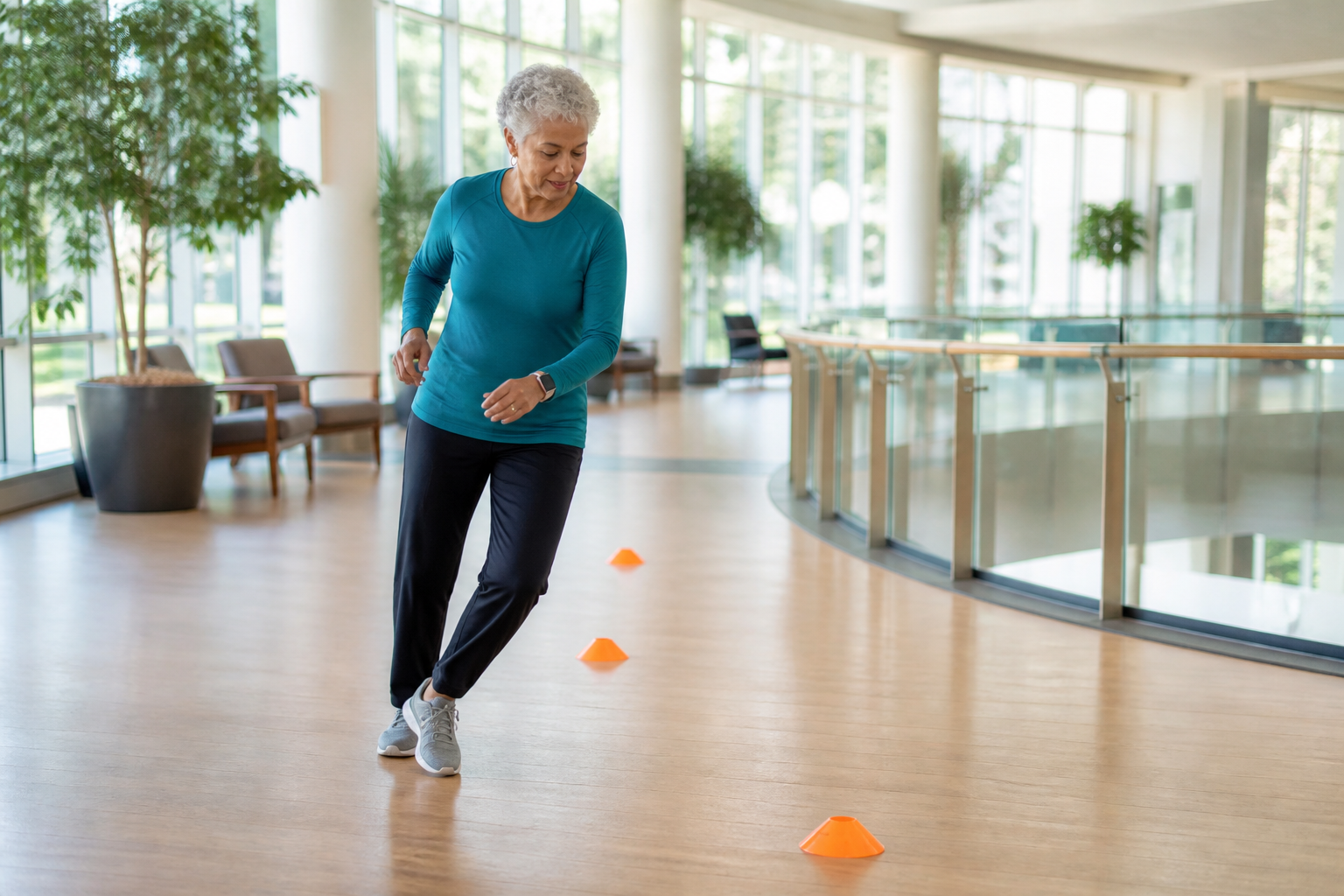
Start on a clear, nonslip surface beside a counter or sturdy rail. Walk several comfortable steps, slow down, look in the new direction, and turn using multiple small steps. Avoid twisting on one planted foot. Practice both directions while staying within a range that does not provoke dizziness or instability.
Progress can include wider arcs, figure-eight walking around two stable markers, or turning to approach a chair before sitting. Strength training, heel raises, step-ups, and balance work support the physical ingredients, while regular walking preserves familiarity with changing environments.
Do not add speed, carrying, conversation, or uneven surfaces all at once. A dual task is useful only after the basic movement is reliable. The goal is adaptable control, not a fastest-turn record.
Turning ability is a compact expression of reserve. Keeping it requires more than strong legs: it depends on sensory information, attention, confidence, and an environment that allows safe movement. Practiced deliberately, direction changes can remain an ordinary part of independence rather than an avoided hazard.
Frequently Asked Questions
Why can turning feel harder than walking straight?
Is a slower turn always a warning sign?
How can turns be practiced safely?
Sources
Stay Updated on Longevity Science
Weekly research digests. No spam, unsubscribe anytime.
Related Articles

Ankle Power and Healthy Aging: The Push-Off That Keeps Walking Efficient
Ankle plantar-flexor power supports walking speed and balance recovery. Learn why push-off changes with age and how strength can be trained safely.
9 min read
Arterial Calcification and Vascular Aging: Reading the Risk Signals
Arterial calcification can reveal accumulated vascular risk. Learn what calcium scores mean, why calcification develops, and where testing has limits.
10 min read
Arterial Stiffness and Vascular Age: A Longevity Evidence Guide
Understand arterial stiffness vascular age longevity links, key studies, measurement limits, and evidence-based lifestyle implications for healthy aging.
11 min read