Skin Autofluorescence and Aging: What the Glow Can Show
Skin autofluorescence estimates fluorescent glycation products, but age, metabolism, skin properties, and device limits all shape the result.
Table of Contents
DISCLAIMER
This article is for informational purposes only and does not constitute medical advice. The statements in this article have not been evaluated by the FDA. The information presented is based on published research and should not be used as a substitute for professional medical guidance. Consult your physician before starting any supplement or health protocol.
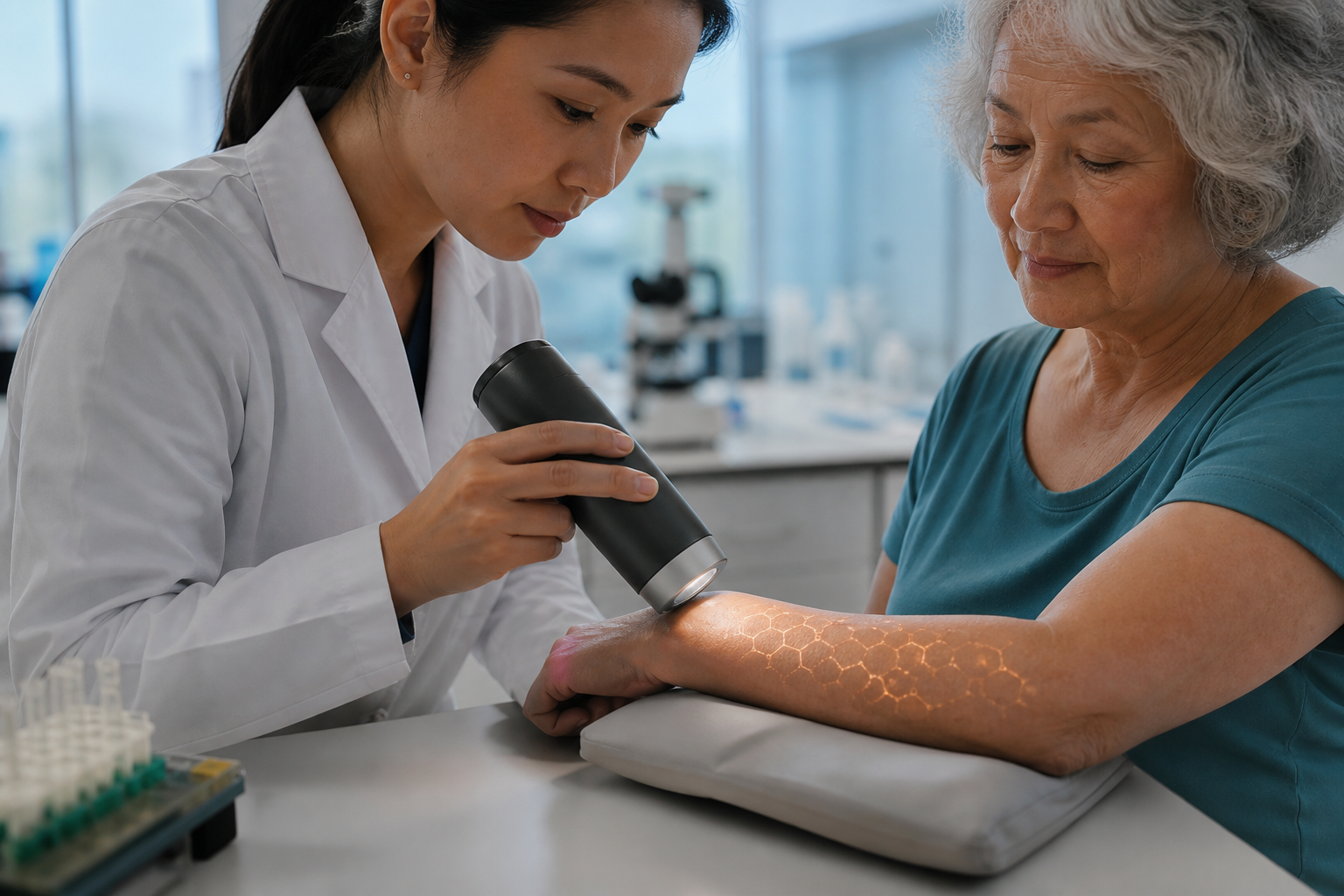
Some molecules in skin emit faint light after they are illuminated with particular wavelengths. A reader can capture that signal in seconds, producing a number called skin autofluorescence. Skin-biopsy research found correlations with several measured AGEs and collagen-linked fluorescence, supporting its use as a proxy for part of accumulated glycation burden rather than a total AGE measurement.
The word “glow” can make the test sound like a direct view of aging. It is not. The optical signal is influenced by chemistry, tissue turnover, skin characteristics, metabolism, and the instrument itself.
What Glycation Does in Tissue
Glycation begins when sugars react nonenzymatically with proteins or lipids. Early products can undergo further reactions and become advanced glycation end products, often shortened to AGEs. Long-lived proteins such as collagen have more time to accumulate these modifications.
Some AGEs can form cross-links that change tissue mechanics. Others may interact with cellular receptors and inflammatory signaling. High glucose exposure can accelerate formation, while oxidative stress and impaired clearance can influence the balance.
AGE is a broad chemical family. Not every AGE fluoresces, and not every fluorescent molecule in skin is an AGE. A light-based reader therefore measures an overlapping signal rather than a complete inventory.
How Skin Autofluorescence Is Measured
A common approach shines controlled ultraviolet or near-ultraviolet light on a small area of the forearm. The device compares emitted fluorescence with reflected excitation light and calculates a ratio. The procedure is noninvasive and quick.
Protocol matters. Creams, recent sun exposure, tattoos, scars, local skin changes, ambient light, and the selected site may affect the result. Devices use particular wavelength ranges and algorithms, so values are not automatically interchangeable.
Skin pigmentation deserves special attention. Greater absorption can weaken or distort the signal, and some instruments cannot produce a reliable reading at higher pigmentation levels (review). Correction algorithms may improve coverage but must be validated across diverse populations. A biomarker that works unequally across skin tones risks turning a technical limitation into a false biological conclusion.
What Studies Associate With the Reading
Skin autofluorescence generally rises with chronological age in populations. Higher values have been reported in diabetes, kidney dysfunction, smokers, and several cardiovascular-risk cohorts, although effect size and independence from conventional risk factors vary by population. A systematic review and meta-analysis found prognostic associations largely in higher-risk clinical populations; this does not establish causation or an individual diagnosis.
These associations are not deterministic. Two people of the same age can differ, and the reasons cannot be recovered from the number alone. A higher reading does not prove a particular diet, glucose pattern, or tissue condition. A lower reading does not guarantee healthy vessels or low future risk.
Population studies may adjust for age and other variables, but residual confounding remains. Illness can both increase AGE accumulation and change clearance. Cross-sectional data cannot always show which came first.
Why It Is Not a Biological-Age Verdict
Aging includes genomic changes, immune remodeling, mitochondrial function, organ reserve, sensory capacity, muscle performance, and social factors. Skin fluorescence observes a narrow optical consequence of some long-lived molecules. Converting it into a universal “AGE age” suggests more certainty than the measurement supports.
Reference values depend on device, population, age range, and exclusion criteria. Because SAF partly reflects compounds associated with long-lived tissue proteins, short-term changes should not automatically be interpreted as biological improvement; measurement variability and protocol differences must first be excluded.
Clinical decisions should remain anchored in validated information such as medical history, blood pressure, glucose measures when appropriate, kidney function, lipids, symptoms, and physical function. Skin autofluorescence may complement research; it does not replace those assessments.
Practical Context Without Score Chasing
Managing blood glucose when clinically indicated, avoiding tobacco, staying active, sleeping consistently, and eating a minimally processed dietary pattern support health through many pathways. Their value does not depend on proving that a skin reader moved.
Claims that a supplement, cream, or short cleanse can “erase AGEs” should be treated cautiously. A cosmetic surface change is not the same as removing modifications from long-lived tissue proteins. A change in SAF caused by a product has not, by itself, been shown to establish improved healthy-aging outcomes.
Researchers still need standardized protocols, diverse validation cohorts, longitudinal studies, and evidence that using the measurement improves decisions. Until then, uncertainty is part of an honest result.
The Bottom Line
Skin autofluorescence offers a convenient research window into fluorescent tissue compounds associated with glycation. It can reflect cumulative exposures at a group level, but it is not a complete AGE measure, a diagnostic test, or a personal biological-age clock.
Frequently Asked Questions
Is skin autofluorescence a biological-age test?
Does a high reading prove high blood sugar?
Can a cream or supplement lower the score?
Sources
- Skin autofluorescence, a novel marker for glycemic and oxidative stress-derived advanced glycation endproducts(2006)
- Skin Autofluorescence—A Non-invasive Measurement for Assessing Cardiovascular Risk and Risk of Diabetes(2014)
- Skin Autofluorescence-Indicated Advanced Glycation End Products as Predictors of Cardiovascular and All-Cause Mortality: A Systematic Review and Meta-analysis(2018)
Stay Updated on Longevity Science
Weekly research digests. No spam, unsubscribe anytime.
Related Articles

Ankle Power and Healthy Aging: The Push-Off That Keeps Walking Efficient
Ankle plantar-flexor power supports walking speed and balance recovery. Learn why push-off changes with age and how strength can be trained safely.
9 min read
Arterial Calcification and Vascular Aging: Reading the Risk Signals
Arterial calcification can reveal accumulated vascular risk. Learn what calcium scores mean, why calcification develops, and where testing has limits.
10 min read
Arterial Stiffness and Vascular Age: A Longevity Evidence Guide
Understand arterial stiffness vascular age longevity links, key studies, measurement limits, and evidence-based lifestyle implications for healthy aging.
11 min read