Red Blood Cell Deformability and Aging: Why Flexibility Matters
Red blood cells must bend through tiny capillaries. Learn how deformability changes with age, what affects it, and why no home test can measure it directly.
Table of Contents
DISCLAIMER
This article is for informational purposes only and does not constitute medical advice. The statements in this article have not been evaluated by the FDA. The information presented is based on published research and should not be used as a substitute for professional medical guidance. Consult your physician before starting any supplement or health protocol.
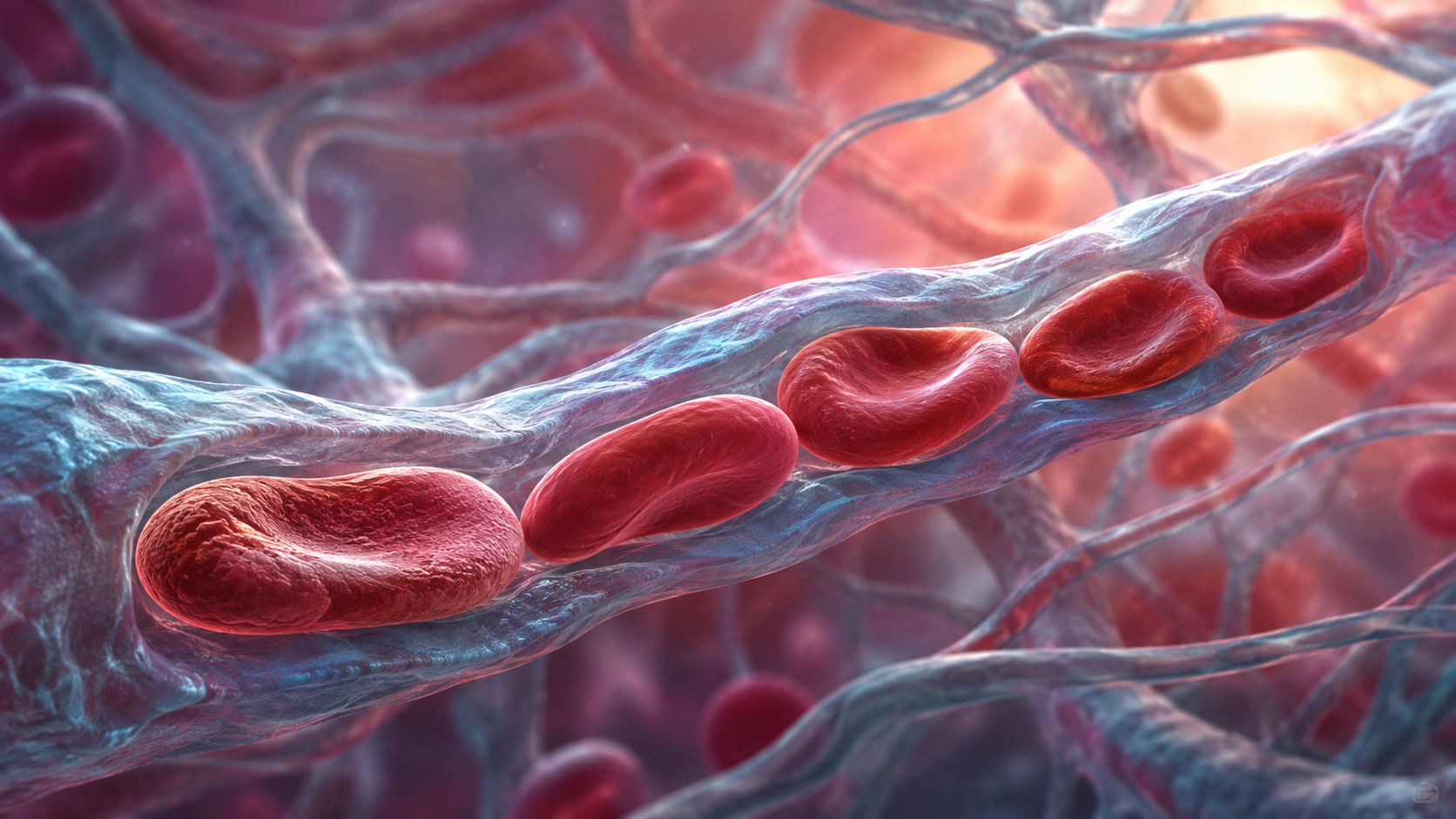
Red blood cells look simple, but their mechanical job is demanding. A resting cell is wider than many capillaries, so it must fold, elongate, and recover thousands of times while carrying oxygen through the circulation.
This ability is called deformability. Research suggests it can be altered by oxidative stress, membrane changes, inflammation, metabolic disease, and aging. The finding is biologically interesting, but it is not a stand-alone diagnosis or a consumer longevity score.
Why red blood cells need to bend
The biconcave shape of a healthy red blood cell provides a large surface area and spare membrane for deformation. A flexible membrane, an adaptable internal skeleton, and the viscosity of hemoglobin inside the cell all influence how easily it changes shape.
In the smallest vessels, cells often move in single file. Deformation reduces flow resistance and keeps the cell surface close to the vessel wall, shortening the distance oxygen must travel. If cells become less flexible, the heart and vascular network may need more pressure to move them through narrow or branching passages.
Deformability is only one part of blood rheology. Hematocrit, plasma proteins, temperature, vessel diameter, and the tendency of cells to aggregate also affect flow. A change measured in a laboratory therefore cannot be translated directly into whole-body oxygen delivery.
How aging may change cell mechanics
Individual red blood cells circulate for roughly 120 days, so the cells in an older adult are not themselves decades old. Aging instead changes the environment in which new cells are made and circulate.
Oxidative damage can modify membrane lipids and proteins. Chronic inflammation and high glucose exposure may alter membrane properties. Kidney disease can affect erythropoietin signaling and red-cell health, while cardiovascular and metabolic conditions can change both the cells and the vessels they pass through.
Studies comparing age groups often report lower average deformability or altered aggregation in older participants, but results depend on health status and measurement technique. Chronological age cannot be isolated cleanly from medication use, disease burden, fitness, or smoking history.
What the measurement can and cannot tell us
Researchers use methods such as ektacytometry, filtration, micropipette aspiration, and microfluidic channels. Each applies a different force or geometry, so two tests may describe different aspects of the same cell population.
Sample collection matters. Storage time, temperature, anticoagulant choice, and shear conditions can change results. This makes deformability useful for controlled research and selected clinical questions, but poorly suited to casual testing or direct comparisons across laboratories.
There is no validated target value that a healthy person should try to optimize. Symptoms such as fatigue, breathlessness, cold hands, or poor exercise tolerance are nonspecific and deserve ordinary medical assessment rather than a presumed diagnosis of rigid blood cells.
Supporting the system that supports red cells
The practical levers are familiar because red-cell mechanics sit inside cardiovascular and metabolic health. Avoiding smoking, managing diabetes and blood pressure, treating kidney or blood disorders, and staying physically active all address established risks to circulation.
Exercise repeatedly challenges oxygen delivery and can improve vascular function, plasma volume, and muscle oxygen extraction. It should be progressed appropriately for a person’s health and mobility. No supplement has been proven to rejuvenate red-cell deformability as a general anti-aging treatment.
The useful lesson is mechanical: oxygen delivery depends not only on how much blood moves, but on whether cells and vessels can adapt to one another at microscopic scale. Red blood cell deformability is a revealing research window into that partnership—not a shortcut health score.
Frequently Asked Questions
What does red blood cell deformability mean?
Can a smartwatch measure red blood cell flexibility?
Does reduced deformability prove poor circulation?
Sources
Stay Updated on Longevity Science
Weekly research digests. No spam, unsubscribe anytime.
Related Articles

Ankle Power and Healthy Aging: The Push-Off That Keeps Walking Efficient
Ankle plantar-flexor power supports walking speed and balance recovery. Learn why push-off changes with age and how strength can be trained safely.
9 min read
Arterial Calcification and Vascular Aging: Reading the Risk Signals
Arterial calcification can reveal accumulated vascular risk. Learn what calcium scores mean, why calcification develops, and where testing has limits.
10 min read
Arterial Stiffness and Vascular Age: A Longevity Evidence Guide
Understand arterial stiffness vascular age longevity links, key studies, measurement limits, and evidence-based lifestyle implications for healthy aging.
11 min read