Cystatin C, Kidney Function, and Aging: A Better Marker or Just Different?
Cystatin C can complement creatinine when estimating kidney filtration, especially when muscle mass complicates interpretation, but it also has non-kidney influences.
Table of Contents
DISCLAIMER
This article is for informational purposes only and does not constitute medical advice. The statements in this article have not been evaluated by the FDA. The information presented is based on published research and should not be used as a substitute for professional medical guidance. Consult your physician before starting any supplement or health protocol.
Kidney function is usually summarized with an estimated glomerular filtration rate, or eGFR. Most routine reports calculate it from serum creatinine, age, and sex. Creatinine is useful and inexpensive, but it is produced by muscle. In an older adult with low muscle mass, a reassuring creatinine concentration can coexist with less filtration than the number appears to suggest.
Cystatin C offers a complementary signal. Nearly all nucleated cells produce this small protein, and healthy kidneys filter it from blood. Because production is less tied to skeletal muscle, cystatin C can clarify kidney estimates in people whose muscle mass makes creatinine difficult to interpret. It is not a perfect replacement, however. The strongest approach often combines the two markers and reads them alongside urine testing and clinical history.
What cystatin C measures
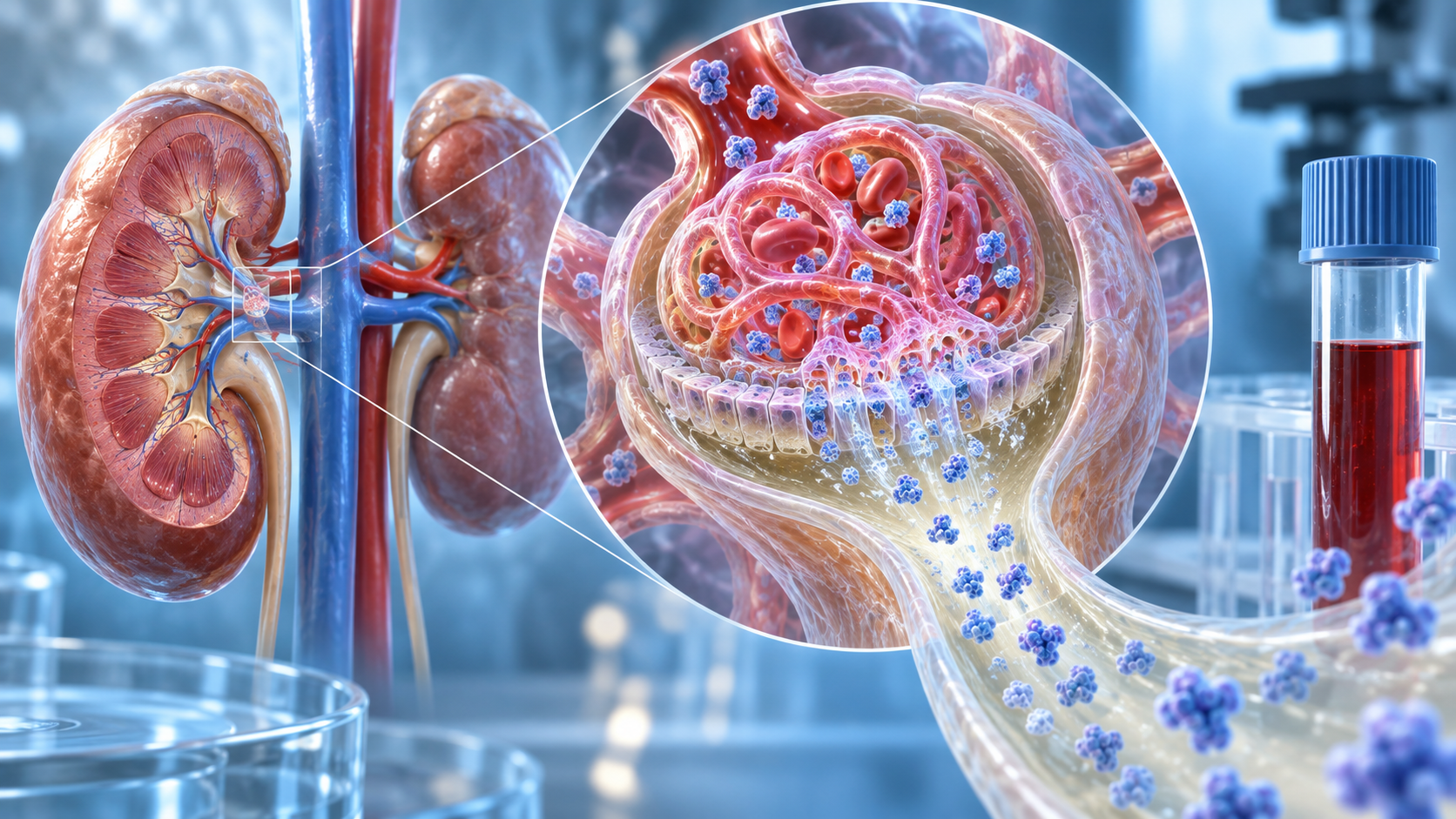
Cystatin C is a protease inhibitor produced at a relatively steady rate by many cells. It passes through the kidney’s glomerular filter and is then largely reabsorbed and broken down in proximal tubular cells rather than returned to the bloodstream. When filtration falls, the blood concentration generally rises.
Laboratories place the result into an equation to estimate GFR. Modern CKD-EPI equations are available for creatinine alone, cystatin C alone, and the combination. The 2021 equations removed race as a coefficient, addressing a long-standing problem in older estimation practices.
An eGFR remains an estimate rather than a direct measurement. Measured GFR uses an external filtration marker and timed samples, which is more involved and reserved for situations where added precision matters. Day-to-day biological variation, assay calibration, acute illness, and hydration-related changes can also influence interpretation.
Chronic kidney disease is not diagnosed from one isolated number alone. A reduced eGFR or another marker of kidney damage, such as elevated urine albumin, generally needs to persist for at least three months unless there is other clear evidence of chronicity. Acute kidney injury follows different timing and diagnostic logic.
Why aging complicates creatinine
Average GFR declines across adulthood, but the rate varies greatly. Aging also changes body composition. Sarcopenia, frailty, immobility, amputation, neuromuscular disease, and low protein intake can lower creatinine generation. In those settings, creatinine-based eGFR may overestimate filtration.
The opposite problem can occur in people with unusually high muscle mass or heavy creatine use, where creatinine may suggest worse filtration than is actually present. Cooked meat shortly before testing can temporarily increase creatinine. Medications can alter tubular handling of creatinine without causing an equivalent change in true filtration.
Cystatin C is attractive because it is less influenced by those muscle-related factors. Studies have also found that cystatin-C-based estimates can predict cardiovascular events, kidney failure, and mortality more strongly than creatinine-based estimates in some cohorts. Part of that stronger association may reflect better filtration measurement; part may reflect non-kidney factors that affect cystatin C and health risk at the same time.
That distinction matters. A biomarker can be useful for risk prediction even if it is not a pure readout of one organ. It should not be described as a direct “kidney age” clock without validated individual interpretation.
When the two markers disagree
Discordance is common enough to deserve attention. An older person may have an eGFR of 75 from creatinine and 48 from cystatin C, for example. The gap does not automatically tell clinicians which marker is correct. They examine body composition, medications, thyroid disease, inflammation, steroid exposure, smoking, recent illness, and the consequences of being wrong.
The combined creatinine–cystatin C equation often performs better than either equation alone because the unrelated biases can partially balance each other. Guidelines support cystatin C as a confirmatory test when creatinine eGFR may be inaccurate and a more reliable estimate would affect decisions.
Examples include confirming whether someone crosses a chronic-kidney-disease threshold, adjusting doses of drugs with narrow safety margins, evaluating a potential kidney donor, or interpreting function in severe frailty. Medication labels and clinical systems do not all use the same equation, so dosing decisions belong with a clinician or pharmacist rather than a consumer calculator.
Urine albumin-to-creatinine ratio adds different information. Filtration can be preserved while albumin leakage signals kidney damage, and reduced filtration can occur without much albuminuria. Blood and urine markers together provide a more complete risk classification.
Non-kidney influences and limitations
Cystatin C is not independent of biology outside the kidney. Glucocorticoid treatment, thyroid dysfunction, inflammation, smoking, and adiposity have been associated with altered concentrations. The size and clinical importance of these effects vary, but they can matter when creatinine and cystatin C strongly disagree.
Acute illness presents another challenge. Biomarkers may be changing faster than equations assume, so an eGFR calculated during rapidly evolving kidney injury can lag behind reality. Clinicians use trends, urine output, cause, and the overall condition rather than treating the displayed eGFR as precise.
Cost and availability also differ. Creatinine is embedded in routine chemistry panels worldwide, while cystatin C may be more expensive or slower. Broader use makes sense where it resolves uncertainty, not simply because a newer marker sounds more advanced.
Reference ranges should not be interpreted without the laboratory method. Standardization has improved, yet results from different assays and dates should still be compared carefully. A change smaller than expected analytical and biological variation may not represent meaningful kidney decline.
A practical way to use the result
Start with the clinical question. If creatinine eGFR is clearly normal, urine albumin is normal, and there is no reason to suspect unusual muscle mass or kidney disease, cystatin C may add little. If a result sits near a threshold or appears inconsistent with the person’s body composition and history, confirmation can be valuable.
Ask for the actual values and equations rather than only “normal” or “abnormal.” Review trends over time, blood pressure, diabetes status, urine albumin, medication list, and prior kidney events. Avoid abrupt changes in supplements or fluid intake merely to improve one lab number.
Kidney-protective care depends on cause and risk. Controlling blood pressure and diabetes when present, avoiding unnecessary nephrotoxic drugs, reviewing medication doses, and following condition-specific guidance have stronger clinical relevance than chasing a cystatin C target.
Cystatin C is best understood as a second angle on filtration. It can reveal uncertainty hidden by creatinine in aging bodies, and the combined estimate can improve accuracy. Its value comes from better context, not from turning another laboratory marker into a universal longevity score.
Frequently Asked Questions
Is cystatin C always more accurate than creatinine?
Does a high cystatin C prove kidney disease?
Should every older adult order cystatin C?
Sources
Stay Updated on Longevity Science
Weekly research digests. No spam, unsubscribe anytime.
Related Articles

Ankle Power and Healthy Aging: The Push-Off That Keeps Walking Efficient
Ankle plantar-flexor power supports walking speed and balance recovery. Learn why push-off changes with age and how strength can be trained safely.
9 min read
Arterial Calcification and Vascular Aging: Reading the Risk Signals
Arterial calcification can reveal accumulated vascular risk. Learn what calcium scores mean, why calcification develops, and where testing has limits.
10 min read
Arterial Stiffness and Vascular Age: A Longevity Evidence Guide
Understand arterial stiffness vascular age longevity links, key studies, measurement limits, and evidence-based lifestyle implications for healthy aging.
11 min read