The Bone Marrow Niche and Aging: How Blood Stem Cells Lose Their Balance
The bone marrow niche guides blood-forming stem cells. Explore how inflammation, stromal cells, and metabolism reshape this environment with age.
Table of Contents
DISCLAIMER
This article is for informational purposes only and does not constitute medical advice. The statements in this article have not been evaluated by the FDA. The information presented is based on published research and should not be used as a substitute for professional medical guidance. Consult your physician before starting any supplement or health protocol.
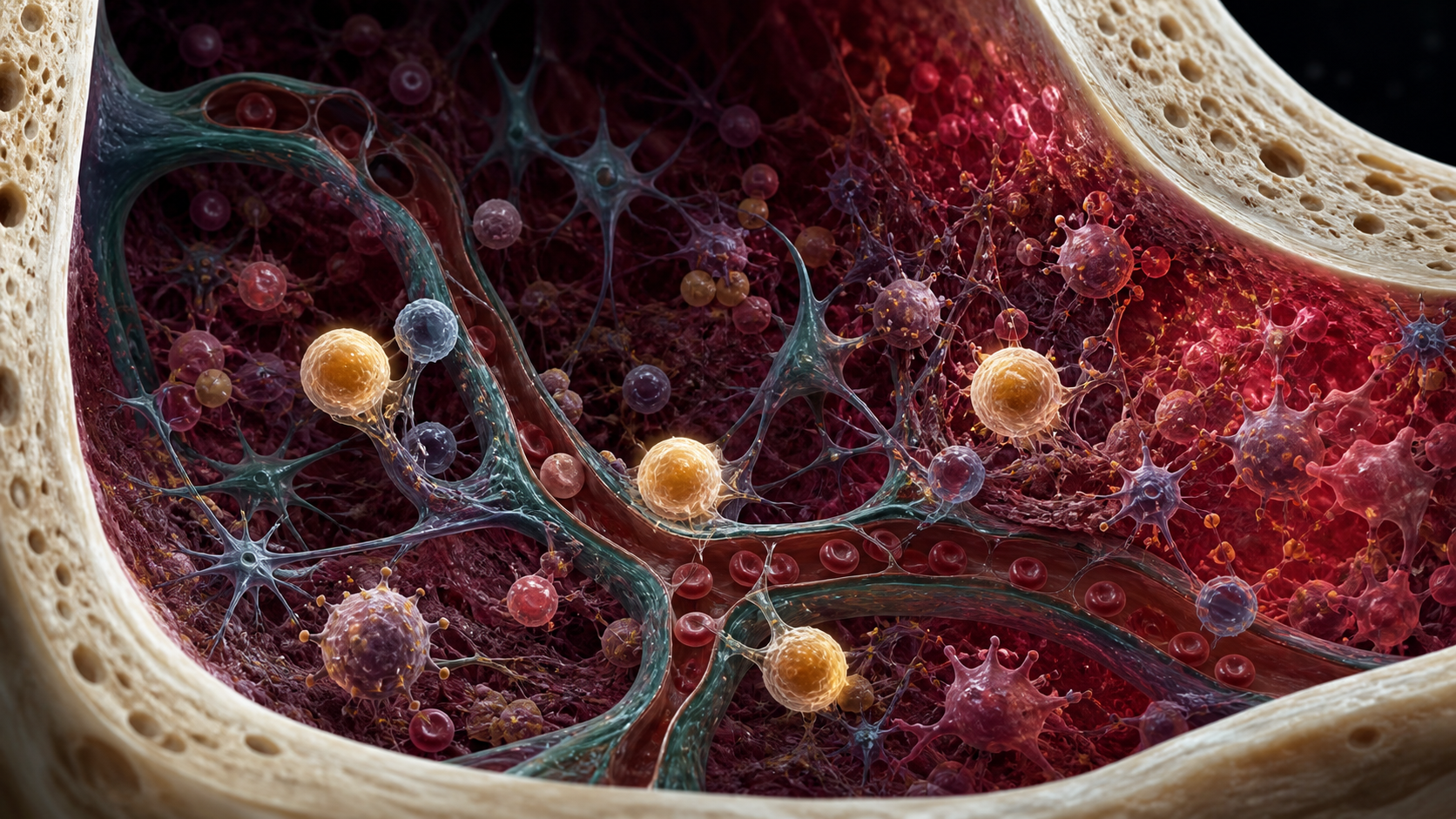
Blood-forming stem cells do not operate alone. They live inside a crowded bone marrow niche made of blood vessels, support cells, nerves, immune cells, bone surfaces, extracellular matrix, and chemical signals. This neighborhood helps decide whether a stem cell rests, self-renews, or produces mature blood cells.
With age, both the stem cells and their surroundings change. Researchers are trying to separate those effects because a cell with accumulated damage may behave differently in a young environment, while even a relatively capable cell can receive distorted instructions from an inflamed niche.
What the Niche Does
Hematopoietic stem cells maintain red blood cells, platelets, and the many branches of the immune system. Most are not dividing constantly. Quiescence protects them from unnecessary replication stress, while rapid activation provides new cells after bleeding, infection, or chemotherapy.
Cells around marrow blood vessels release factors that help preserve this balance. Endothelial cells line the vessels; mesenchymal stromal cells provide structural and chemical support; nerve signals connect marrow activity to daily rhythms and stress responses. Mature immune cells can feed information back into the system.
There is no single circular “stem-cell nest.” Niches are distributed and dynamic. Different imaging methods and markers reveal overlapping cell populations, and the important relationships can change during injury or disease.
How Aging Shifts Blood Production
Aged hematopoietic stem-cell populations often show reduced regenerative performance and a bias toward myeloid lineages at the expense of some lymphoid output. This pattern may contribute to weaker adaptive immune responses and a greater tendency toward inflammatory cells, although human immune aging has many additional causes.
Inside stem cells, DNA damage, epigenetic change, altered metabolism, protein-quality stress, and abnormal polarity can accumulate. In the niche, vascular function, stromal-cell composition, bone remodeling, and inflammatory signaling may shift. These changes can reinforce one another.
Clonal hematopoiesis adds another layer. A stem cell with an acquired mutation may expand because the mutation gives it a competitive advantage. The condition becomes more common with age and can be associated with blood-cancer and cardiovascular risk, but many people never develop a malignancy. It is a clinical finding, not a direct synonym for leukemia.
What Can Be Measured in People
Routine complete blood counts measure mature cells, not niche quality. Abnormal counts can have many causes, including nutritional deficiency, infection, medications, kidney disease, bleeding, or marrow disorders. They cannot reveal whether a particular vessel or stromal signal has aged.
Bone marrow aspiration and biopsy provide more direct information when medically indicated, but they are not general longevity tests. Genetic sequencing may identify clonal hematopoiesis in research or clinical contexts. Interpretation depends on the mutation, clone size, blood counts, medical history, and evolving guidelines.
Animal transplantation experiments can distinguish cell-intrinsic from environmental effects more directly than human studies can. Their findings generate hypotheses, but a mouse niche intervention is not evidence that a consumer therapy rejuvenates human blood production.
Supporting Blood Health Without Overclaiming
Vaccination, physical activity appropriate to ability, smoking avoidance, sleep, and management of chronic disease support immune and cardiovascular health even though they are not targeted niche-rejuvenation treatments. Adequate iron, vitamin B12, folate, protein, and other nutrients matter when a deficiency exists; excess supplementation does not create younger stem cells.
Persistent anemia, unusual bruising, recurrent infections, unexplained fatigue, or abnormal blood counts should be evaluated clinically. Treating a specific cause is more useful than trying to manipulate an invisible niche with unvalidated products.
The marrow niche illustrates a central principle of aging biology: cell behavior depends on context. Future therapies may need to address both damaged stem-cell clones and the environment that selects or instructs them. For now, the science is advancing faster than routine clinical tools for measuring—or resetting—that environment.
Frequently Asked Questions
What is the bone marrow niche?
Does bone marrow aging cause every immune problem?
Can a supplement rejuvenate the bone marrow niche?
Sources
Stay Updated on Longevity Science
Weekly research digests. No spam, unsubscribe anytime.
Related Articles

Ankle Power and Healthy Aging: The Push-Off That Keeps Walking Efficient
Ankle plantar-flexor power supports walking speed and balance recovery. Learn why push-off changes with age and how strength can be trained safely.
9 min read
Arterial Calcification and Vascular Aging: Reading the Risk Signals
Arterial calcification can reveal accumulated vascular risk. Learn what calcium scores mean, why calcification develops, and where testing has limits.
10 min read
Arterial Stiffness and Vascular Age: A Longevity Evidence Guide
Understand arterial stiffness vascular age longevity links, key studies, measurement limits, and evidence-based lifestyle implications for healthy aging.
11 min read