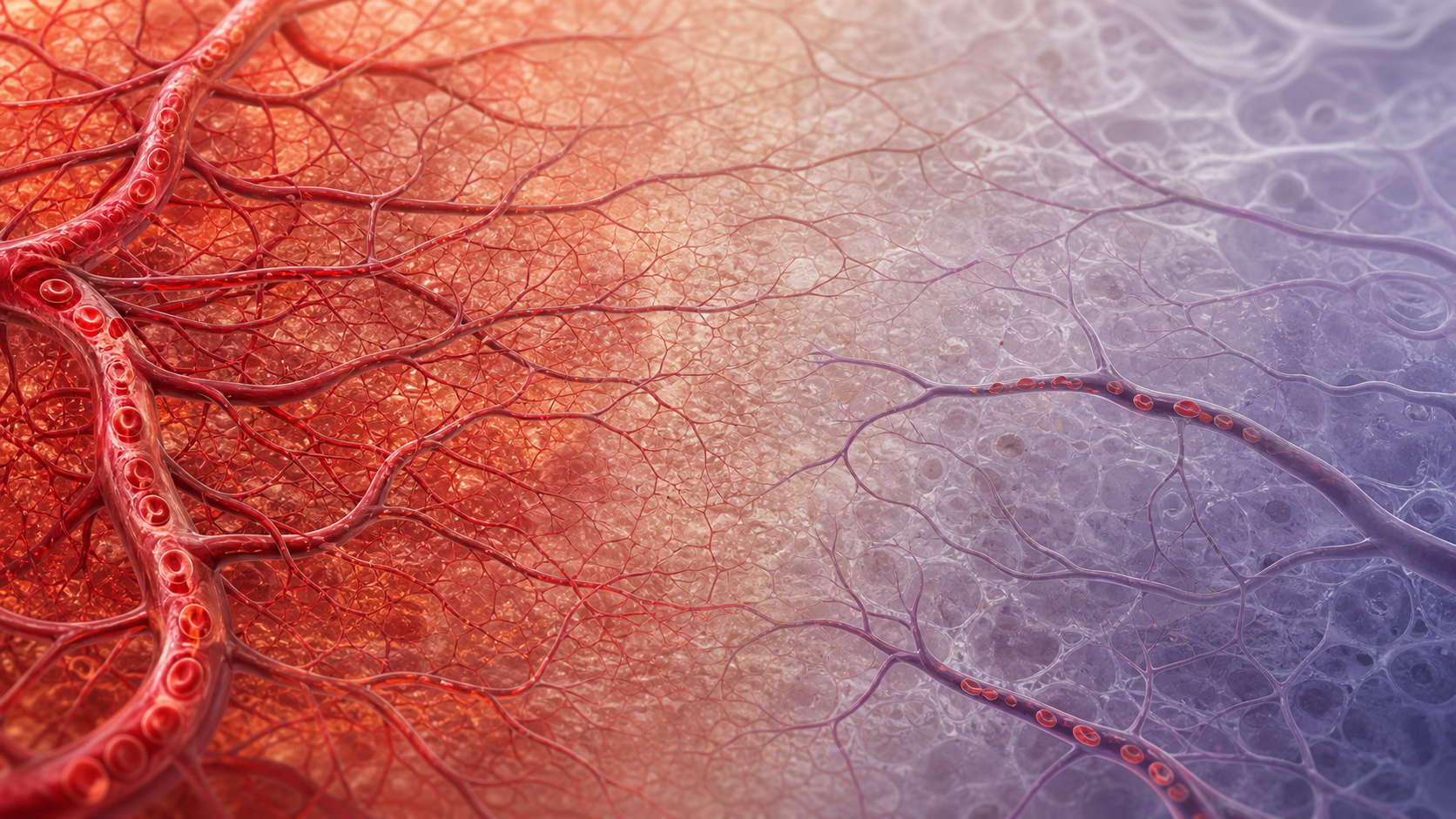
Capillary Rarefaction and Aging: When Tissues Lose Their Smallest Blood Vessels
Capillary rarefaction can reduce microvascular reserve. Learn what researchers know, how it is measured, and what remains uncertain.
Table of Contents
DISCLAIMER
This article is for informational purposes only and does not constitute medical advice. The statements in this article have not been evaluated by the FDA. The information presented is based on published research and should not be used as a substitute for professional medical guidance. Consult your physician before starting any supplement or health protocol.
Large arteries dominate diagrams of circulation, but most exchange happens in vessels too small to see without magnification. Capillaries deliver oxygen and nutrients across a short distance, collect metabolic products, and help tissues match blood flow to local demand.
With age and several chronic diseases, some tissues show capillary rarefaction—a decrease in the density or functional recruitment of these vessels. The concept helps explain why normal-looking blood pressure or a patent large artery does not always guarantee abundant microvascular reserve.
Structural and Functional Rarefaction
Structural rarefaction means that capillary segments have physically disappeared. Functional rarefaction describes vessels that remain present but carry little or no blood under the conditions measured. Vasoconstriction, impaired red-blood-cell passage, and abnormal flow distribution can make a network behave as though it has fewer vessels.
The distinction matters because a temporarily underused vessel may be recruitable, while a lost vessel requires remodeling or new growth. In practice, it can be difficult to separate the two. A snapshot of blood flow may miss intermittent perfusion, and a tissue sample cannot show dynamic recruitment.
Microvascular networks differ by organ. Skeletal muscle adjusts flow dramatically with exercise. Skin participates in temperature control. The kidney has specialized capillary beds for filtration, and the brain tightly coordinates local neural activity with blood supply. There is no single body-wide capillary score.
Why Networks Become Sparser
Capillary maintenance depends on signals between endothelial cells, support cells called pericytes, tissue cells, immune cells, and the extracellular matrix. Vascular endothelial growth factor and other pathways influence survival and growth, while nitric oxide helps vessels dilate and respond to shear stress.
Aging can alter endothelial signaling, mitochondrial function, inflammation, matrix stiffness, and the ability to respond to low oxygen. Hypertension can expose delicate vessels to abnormal pressure and remodeling. Diabetes can damage microvascular structure and regulation. Physical inactivity reduces repeated demand for high muscle blood flow.
Cause and consequence can reinforce one another. A sparse network increases resistance and reduces delivery reserve; high pressure and metabolic stress can then place more strain on the remaining network. However, rarefaction is not an inevitable, uniform loss in every person or organ.
How Researchers Measure It
Nailfold capillaroscopy visualizes vessels near the fingernails and is clinically useful for selected connective-tissue diseases. Retinal imaging provides a window into small vessels of the eye. Contrast imaging, microscopy of tissue samples, and measurements of reactive blood flow can address other questions.
Each method samples a particular place and property. Vessel diameter is not the same as vessel number; blood-flow response is not a direct anatomical count. Findings from skin or muscle cannot automatically be transferred to the heart, kidney, or brain.
Symptoms are equally nonspecific. Fatigue, cold hands, exercise intolerance, slow healing, or cognitive change can arise from many conditions. They should not be self-diagnosed as capillary loss.
What Supports Microvascular Health
Regular physical activity creates repeated signals for active muscle to improve oxygen delivery and extraction. Aerobic exercise can enhance endothelial function, while resistance training increases the metabolic capacity and demand of muscle. Appropriate progression matters for people with cardiovascular, metabolic, or mobility limitations.
Blood-pressure control, diabetes management, smoking avoidance, and treatment of sleep apnea or vascular disease address established sources of microvascular stress. A varied diet supports overall cardiovascular health, but no supplement has been proven to rebuild capillaries throughout an aging human body.
Capillary rarefaction is best understood as a loss of reserve within a living network. The practical goal is not to chase a theoretical capillary count. It is to protect the conditions that let small vessels remain responsive, perfused, and matched to the tissues they serve.
Frequently Asked Questions
What is capillary rarefaction?
Can a consumer device measure capillary density?
Does exercise grow new capillaries?
Sources
Stay Updated on Longevity Science
Weekly research digests. No spam, unsubscribe anytime.
Related Articles

Ankle Power and Healthy Aging: The Push-Off That Keeps Walking Efficient
Ankle plantar-flexor power supports walking speed and balance recovery. Learn why push-off changes with age and how strength can be trained safely.
9 min read
Arterial Calcification and Vascular Aging: Reading the Risk Signals
Arterial calcification can reveal accumulated vascular risk. Learn what calcium scores mean, why calcification develops, and where testing has limits.
10 min read
Arterial Stiffness and Vascular Age: A Longevity Evidence Guide
Understand arterial stiffness vascular age longevity links, key studies, measurement limits, and evidence-based lifestyle implications for healthy aging.
11 min read